

GCC Meat Market Size to Hit 6.80 Million Tons by 2033 | With a 3.07% CAGR
GCC Meat Market
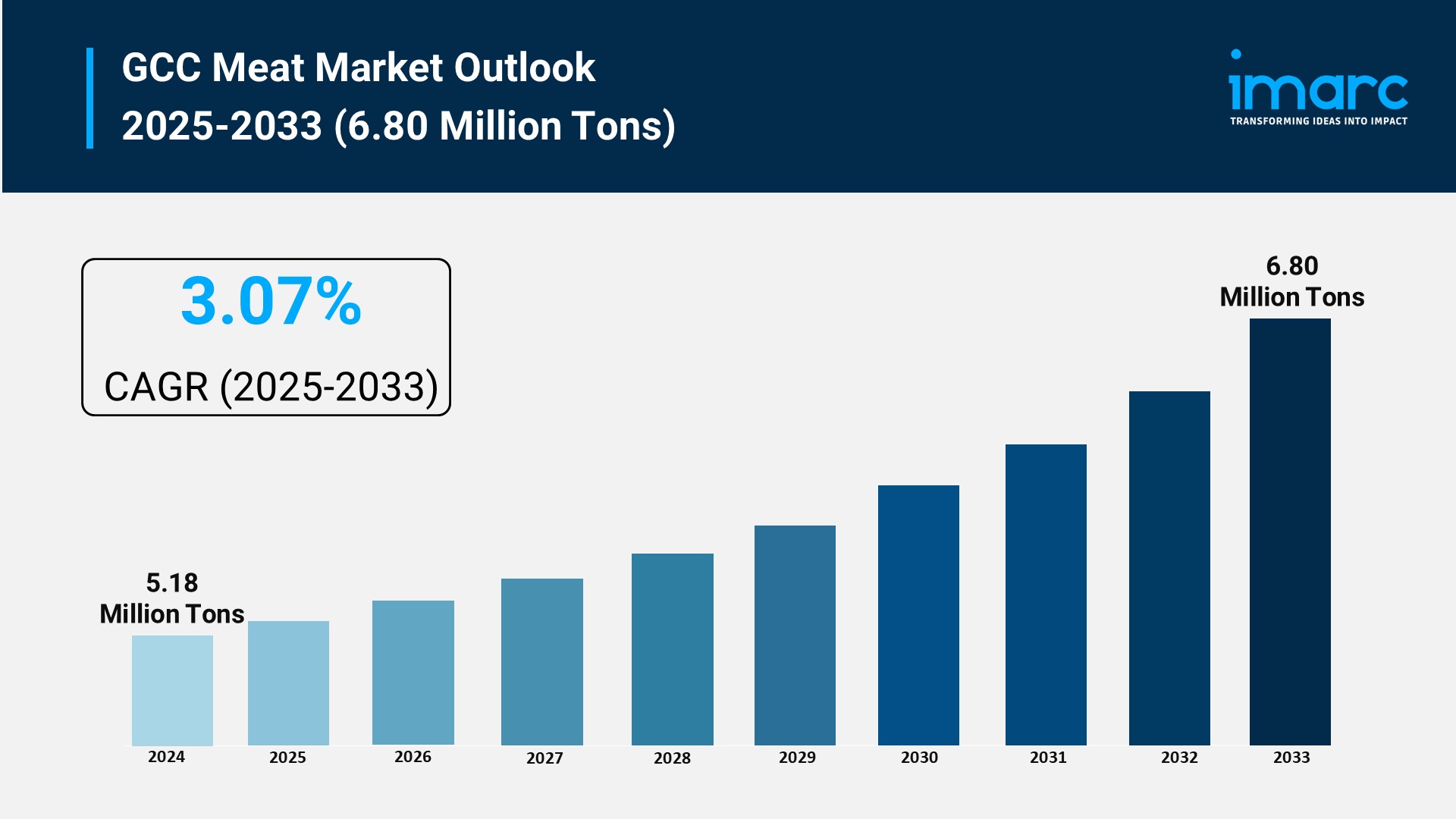
GCC meat market size was valued at 5.18 Million Tons in 2024, expected to reach 6.80 Million Tons at a CAGR of 3.07% during 2025-2033.
SHERIDAN, WY, UNITED STATES, November 19, 2025 /EINPresswire.com/ -- 𝐆𝐂𝐂 𝐌𝐞𝐚𝐭 𝐌𝐚𝐫𝐤𝐞𝐭 𝐎𝐯𝐞𝐫𝐯𝐢𝐞𝐰𝐌𝐚𝐫𝐤𝐞𝐭 𝐒𝐢𝐳𝐞 𝐢𝐧 𝟐𝟎𝟐𝟒: 5.18 Million Tons
𝐌𝐚𝐫𝐤𝐞𝐭 𝐒𝐢𝐳𝐞 𝐢𝐧 𝟐𝟎𝟑𝟑: 6.80 Million Tons
𝐌𝐚𝐫𝐤𝐞𝐭 𝐆𝐫𝐨𝐰𝐭𝐡 𝐑𝐚𝐭𝐞 𝟐𝟎𝟐𝟓-𝟐𝟎𝟑𝟑: 3.07%
According to IMARC Group's latest research publication, "𝐆𝐂𝐂 𝐌𝐞𝐚𝐭 𝐌𝐚𝐫𝐤𝐞𝐭: 𝐈𝐧𝐝𝐮𝐬𝐭𝐫𝐲 𝐓𝐫𝐞𝐧𝐝𝐬, 𝐒𝐡𝐚𝐫𝐞, 𝐒𝐢𝐳𝐞, 𝐆𝐫𝐨𝐰𝐭𝐡, 𝐎𝐩𝐩𝐨𝐫𝐭𝐮𝐧𝐢𝐭𝐲 𝐚𝐧𝐝 𝐅𝐨𝐫𝐞𝐜𝐚𝐬𝐭 𝟐𝟎𝟐𝟓-𝟐𝟎𝟑𝟑", the GCC meat market size was valued at 5.18 Million Tons in 2024. Looking forward, IMARC Group estimates the market to reach 6.80 Million Tons by 2033, exhibiting a CAGR of 3.07% during 2025-2033.
𝐇𝐨𝐰 𝐀𝐈 𝐢𝐬 𝐑𝐞𝐬𝐡𝐚𝐩𝐢𝐧𝐠 𝐭𝐡𝐞 𝐅𝐮𝐭𝐮𝐫𝐞 𝐨𝐟 𝐆𝐂𝐂 𝐌𝐞𝐚𝐭 𝐌𝐚𝐫𝐤𝐞𝐭
● Precision Farming Enhancements: AI-driven analytics optimize livestock feed and health monitoring, reducing costs by up to 20% in Saudi Arabia's poultry sector. Predictive models forecast disease outbreaks, boosting yields and self-sufficiency rates toward 80% by 2030, transforming traditional rearing into data-centric operations for sustainable growth.
● Supply Chain Optimization: Blockchain-integrated AI ensures halal traceability from farm to table, minimizing waste in UAE's import-heavy market. Real-time logistics adjustments cut delivery times by 15%, enhancing freshness and consumer trust amid rising tourism demands.
● Demand Forecasting Tools: Machine learning algorithms analyze consumer trends for premium meats, aiding processors in Qatar to adjust production dynamically. This reduces overstock by 25%, aligning with population growth and urbanization for efficient market responsiveness.
● Quality Control Automation: Computer vision inspects cuts for defects in Oman's facilities, improving export standards. AI slashes rejection rates by 30%, supporting regional expansion into halal-certified global niches.
𝐃𝐨𝐰𝐧𝐥𝐨𝐚𝐝 𝐚 𝐬𝐚𝐦𝐩𝐥𝐞 𝐜𝐨𝐩𝐲 𝐨𝐟 𝐭𝐡𝐞 𝐑𝐞𝐩𝐨𝐫𝐭: https://www.imarcgroup.com/gcc-meat-market/requestsample
𝐇𝐨𝐰 𝐕𝐢𝐬𝐢𝐨𝐧 𝟐𝟎𝟑𝟎 𝐢𝐬 𝐑𝐞𝐯𝐨𝐥𝐮𝐭𝐢𝐨𝐧𝐢𝐳𝐢𝐧𝐠 𝐆𝐂𝐂 𝐌𝐞𝐚𝐭 𝐈𝐧𝐝𝐮𝐬𝐭𝐫𝐲
Saudi Arabia's Vision 2030 spearheads a transformative shift in the GCC meat sector, emphasizing food security and diversification away from oil dependency. With USD 5 billion allocated for poultry infrastructure, the initiative targets 80% self-sufficiency by 2025, up from 68% in 2022, through modern farms and tech upgrades. This cascades across the GCC, inspiring UAE's USD 4.5 billion poultry investments to hit 1.3 million metric tons annually, fostering regional collaboration on halal standards and export hubs.
Beyond production, Vision 2030 promotes sustainable practices like water-efficient rearing amid arid climates, integrating renewables to cut emissions by 15%. Consumer shifts toward premium, traceable meats align with tourism booms, with Qatar and Bahrain leveraging expo legacies for high-end processing plants. Overall, it catalyzes a USD 12.79 billion market by 2030, blending policy incentives with private ventures for resilient supply chains. This holistic approach not only curbs imports but elevates GCC as a halal meat powerhouse, ensuring nutritional access for a burgeoning population while driving economic multipliers in agrotech and logistics.
𝐆𝐂𝐂 𝐌𝐞𝐚𝐭 𝐌𝐚𝐫𝐤𝐞𝐭 𝐓𝐫𝐞𝐧𝐝𝐬 & 𝐃𝐫𝐢𝐯𝐞𝐫𝐬:
GCC meat market is also witnessing a consistent growth due to the vision 2030 programs by members countries that are based on food security and production potential. Saudi Arabia and the UAE are developing strong distribution networks through investments in agricultural infrastructure and strategic location of the region as a food hub respectively. The government programmes that encourage the local livestock farming and meat processing plant are lowering the level of import dependence and the investments in cold chain technology that guarantee the preservation of quality throughout the entire region adversarial climate.
The increased consumer demand to have sources of high quality proteins is changing the GCC meat scene, where there is an increase in the consumption of high quality cuts and organic products. The growing number of expatriates in the region and the rising tourism industry are diversifying the consumption levels by pushing a demand of international meat type in addition to the traditional ones. The lean protein products are growing due to young and health-conscious consumers, and the increasing food service sector needs a continuous and supply of high-quality meat product in the restaurants and hospitality industry of the region.
Halal certification has been a significant market force that GCC countries have enhanced regulatory frameworks and certification systems to ensure market integrity. The geographic position of the area as a trade centre between Asia, Africa and Europe puts it in an ideal location to export of meat re-export. Local production efficiency is being enhanced by the use of technology in livestock farming such as smart feeding systems, and health monitoring. Also, the expanding processed meat industry, fueled by hectic lifestyles and the need to have ready meals in the urban areas, is opening up new markets in all GCC countries.
𝐀𝐬𝐤 𝐚𝐧𝐚𝐥𝐲𝐬𝐭 𝐨𝐟 𝐜𝐮𝐬𝐭𝐨𝐦𝐢𝐳𝐞𝐝 𝐫𝐞𝐩𝐨𝐫𝐭: https://www.imarcgroup.com/request?type=report&id=10231&flag=E
𝐆𝐂𝐂 𝐌𝐞𝐚𝐭 𝐈𝐧𝐝𝐮𝐬𝐭𝐫𝐲 𝐒𝐞𝐠𝐦𝐞𝐧𝐭𝐚𝐭𝐢𝐨𝐧:
The report has segmented the market into the following categories:
𝐀𝐧𝐚𝐥𝐲𝐬𝐢𝐬 𝐛𝐲 𝐓𝐲𝐩𝐞:
● Raw
● Processed
𝐀𝐧𝐚𝐥𝐲𝐬𝐢𝐬 𝐛𝐲 𝐏𝐫𝐨𝐝𝐮𝐜𝐭:
● Chicken
● Beef
● Pork
● Mutton
● Others
𝐀𝐧𝐚𝐥𝐲𝐬𝐢𝐬 𝐛𝐲 𝐃𝐢𝐬𝐭𝐫𝐢𝐛𝐮𝐭𝐢𝐨𝐧 𝐂𝐡𝐚𝐧𝐧𝐞𝐥:
● Supermarkets and Hypermarkets
● Departmental Stores
● Specialty Stores
● Online Stores
● Others
𝐂𝐨𝐮𝐧𝐭𝐫𝐲 𝐀𝐧𝐚𝐥𝐲𝐬𝐢𝐬:
● Saudi Arabia
● UAE
● Qatar
● Bahrain
● Kuwait
● Oman
𝐂𝐨𝐦𝐩𝐞𝐭𝐢𝐭𝐢𝐯𝐞 𝐋𝐚𝐧𝐝𝐬𝐜𝐚𝐩𝐞:
The competitive landscape of the industry has also been examined along with the profiles of the key players.
𝐑𝐞𝐜𝐞𝐧𝐭 𝐍𝐞𝐰𝐬 𝐚𝐧𝐝 𝐃𝐞𝐯𝐞𝐥𝐨𝐩𝐦𝐞𝐧𝐭𝐬 𝐢𝐧 𝐆𝐂𝐂 𝐌𝐞𝐚𝐭 𝐌𝐚𝐫𝐤𝐞𝐭
● 𝐉𝐚𝐧𝐮𝐚𝐫𝐲 𝟐𝟎𝟐𝟓: Saudi Arabia's NEOM announced a $2.5 billion investment in sustainable livestock farming, incorporating advanced genetic technologies and AI-driven feed optimization to produce premium meat products for local and export markets.
● 𝐅𝐞𝐛𝐫𝐮𝐚𝐫𝐲 𝟐𝟎𝟐𝟓: UAE's Al Dahra Holding acquired three major meat processing facilities across GCC countries, expanding production capacity by 40% and introducing blockchain-based traceability systems for enhanced food safety.
● 𝐌𝐚𝐫𝐜𝐡 𝟐𝟎𝟐𝟓: Qatar's Ministry of Municipality launched the "Smart Meat Initiative," implementing IoT sensors in 150 local farms to monitor animal welfare and optimize meat quality, targeting a 30% increase in local production by 2026.
𝐎𝐭𝐡𝐞𝐫 𝐓𝐫𝐞𝐧𝐝𝐢𝐧𝐠 𝐑𝐞𝐩𝐨𝐫𝐭𝐬 𝐁𝐲 𝐈𝐌𝐀𝐑𝐂 𝐆𝐫𝐨𝐮𝐩:
GCC Chocolate Market Research Report
GCC Cryptocurrency Market Research Report
GCC Electric Car Market: https://www.imarcgroup.com/gcc-electric-car-market
GCC Real Estate Market: https://www.imarcgroup.com/gcc-real-estate-market
𝐍𝐨𝐭𝐞: 𝐈𝐟 𝐲𝐨𝐮 𝐫𝐞𝐪𝐮𝐢𝐫𝐞 𝐬𝐩𝐞𝐜𝐢𝐟𝐢𝐜 𝐝𝐞𝐭𝐚𝐢𝐥𝐬, 𝐝𝐚𝐭𝐚, 𝐨𝐫 𝐢𝐧𝐬𝐢𝐠𝐡𝐭𝐬 𝐭𝐡𝐚𝐭 𝐚𝐫𝐞 𝐧𝐨𝐭 𝐜𝐮𝐫𝐫𝐞𝐧𝐭𝐥𝐲 𝐢𝐧𝐜𝐥𝐮𝐝𝐞𝐝 𝐢𝐧 𝐭𝐡𝐞 𝐬𝐜𝐨𝐩𝐞 𝐨𝐟 𝐭𝐡𝐢𝐬 𝐫𝐞𝐩𝐨𝐫𝐭, 𝐰𝐞 𝐚𝐫𝐞 𝐡𝐚𝐩𝐩𝐲 𝐭𝐨 𝐚𝐜𝐜𝐨𝐦𝐦𝐨𝐝𝐚𝐭𝐞 𝐲𝐨𝐮𝐫 𝐫𝐞𝐪𝐮𝐞𝐬𝐭. 𝐀𝐬 𝐩𝐚𝐫𝐭 𝐨𝐟 𝐨𝐮𝐫 𝐜𝐮𝐬𝐭𝐨𝐦𝐢𝐳𝐚𝐭𝐢𝐨𝐧 𝐬𝐞𝐫𝐯𝐢𝐜𝐞, 𝐰𝐞 𝐰𝐢𝐥𝐥 𝐠𝐚𝐭𝐡𝐞𝐫 𝐚𝐧𝐝 𝐩𝐫𝐨𝐯𝐢𝐝𝐞 𝐭𝐡𝐞 𝐚𝐝𝐝𝐢𝐭𝐢𝐨𝐧𝐚𝐥 𝐢𝐧𝐟𝐨𝐫𝐦𝐚𝐭𝐢𝐨𝐧 𝐲𝐨𝐮 𝐧𝐞𝐞𝐝, 𝐭𝐚𝐢𝐥𝐨𝐫𝐞𝐝 𝐭𝐨 𝐲𝐨𝐮𝐫 𝐬𝐩𝐞𝐜𝐢𝐟𝐢𝐜 𝐫𝐞𝐪𝐮𝐢𝐫𝐞𝐦𝐞𝐧𝐭𝐬. 𝐏𝐥𝐞𝐚𝐬𝐞 𝐥𝐞𝐭 𝐮𝐬 𝐤𝐧𝐨𝐰 𝐲𝐨𝐮𝐫 𝐞𝐱𝐚𝐜𝐭 𝐧𝐞𝐞𝐝𝐬, 𝐚𝐧𝐝 𝐰𝐞 𝐰𝐢𝐥𝐥 𝐞𝐧𝐬𝐮𝐫𝐞 𝐭𝐡𝐞 𝐫𝐞𝐩𝐨𝐫𝐭 𝐢𝐬 𝐮𝐩𝐝𝐚𝐭𝐞𝐝 𝐚𝐜𝐜𝐨𝐫𝐝𝐢𝐧𝐠𝐥𝐲 𝐭𝐨 𝐦𝐞𝐞𝐭 𝐲𝐨𝐮𝐫 𝐞𝐱𝐩𝐞𝐜𝐭𝐚𝐭𝐢𝐨𝐧𝐬.
𝐀𝐛𝐨𝐮𝐭 𝐔𝐬:
IMARC Group is a global management consulting firm that helps the world's most ambitious changemakers to create a lasting impact. The company provides a comprehensive suite of market entry and expansion services. IMARC offerings include thorough market assessment, feasibility studies, company incorporation assistance, factory setup support, regulatory approvals and licensing navigation, branding, marketing and sales strategies, competitive landscape and benchmarking analyses, pricing and cost research, and procurement research.
𝐂𝐨𝐧𝐭𝐚𝐜𝐭 𝐔𝐬:
IMARC Group
134 N 4th St. Brooklyn, NY 11249, USA
Email: sales@imarcgroup.com
Tel No:(D) +91 120 433 0800
United States: +1-201971-6302
Elena Anderson
IMARC Services Private Limited
+ +1 201-971-6302
email us here
Legal Disclaimer:
EIN Presswire provides this news content "as is" without warranty of any kind. We do not accept any responsibility or liability for the accuracy, content, images, videos, licenses, completeness, legality, or reliability of the information contained in this article. If you have any complaints or copyright issues related to this article, kindly contact the author above.
